

[archived]Experience the Calm of “Water & Leaf Shadows” by Akihiko Okada
This article may contain outdated information.
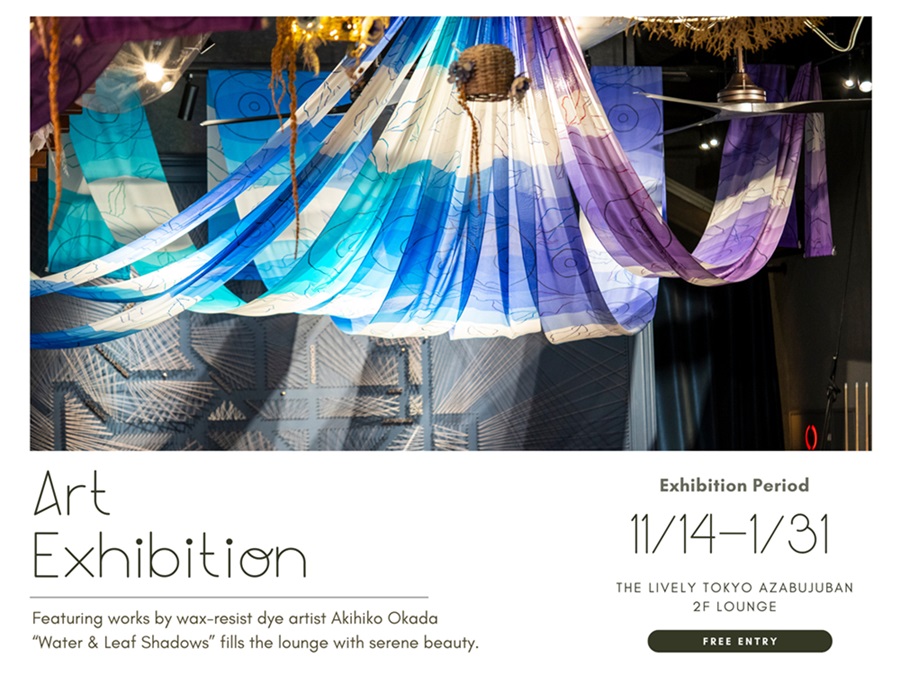
Since November 14, the second-floor lounge of THE LIVELY TOKYO AZABUJYUBAN has been reimagined through the work of Akihiko Okada, a contemporary artist known for his mastery of rōketsu-zome, Japan’s traditional wax-resist dyeing technique.
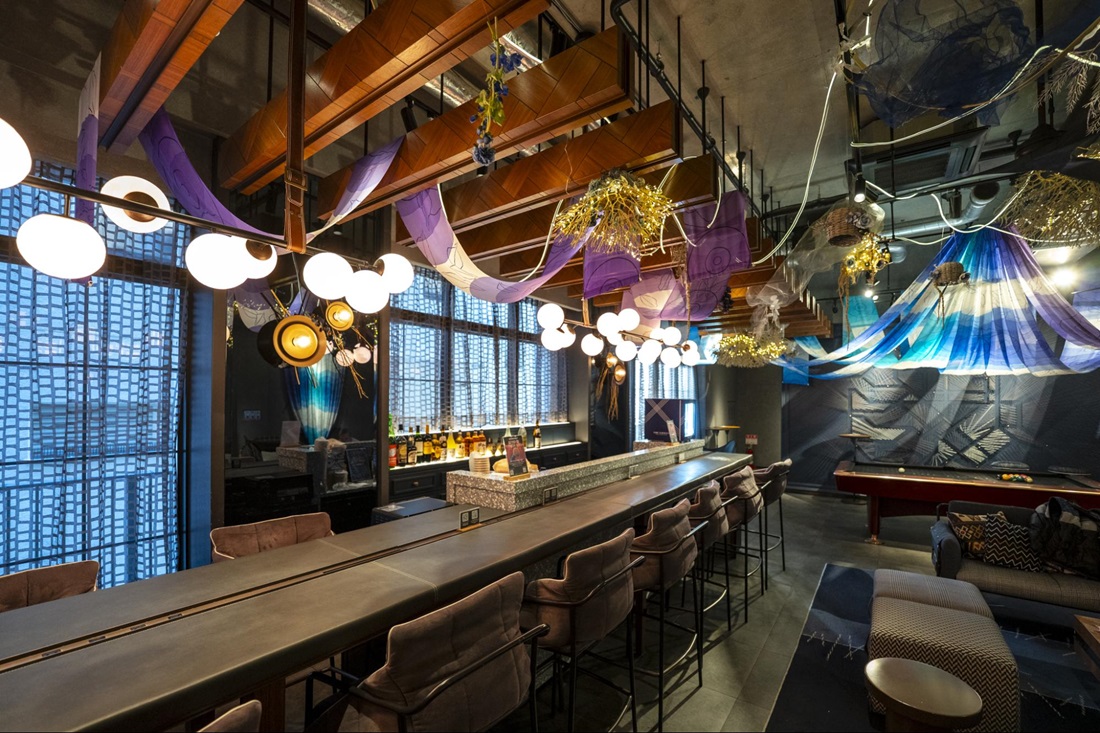
Titled “IRODORI KANADERU,” the exhibition welcomes guests with a series of long, flowing silk panels that cascade gently from the ceiling. Each panel carries its own tone of blue—sometimes shaded with green, sometimes drifting toward violet—forming a quiet yet confident rhythm as the colors shift from one piece to the next.
Near the entrance, the silk is drawn tightly together. As you move deeper into the space, the panels gradually fan out, suspended at even intervals from the lounge’s wooden framework. Weighted at their centers, the fabric curves into soft arcs, evoking a winter mountain range dusted with frost. Toward the floor, the folds widen and the exhibition’s recurring motifs begin to emerge: flowing water and the delicate shadows of leaves.
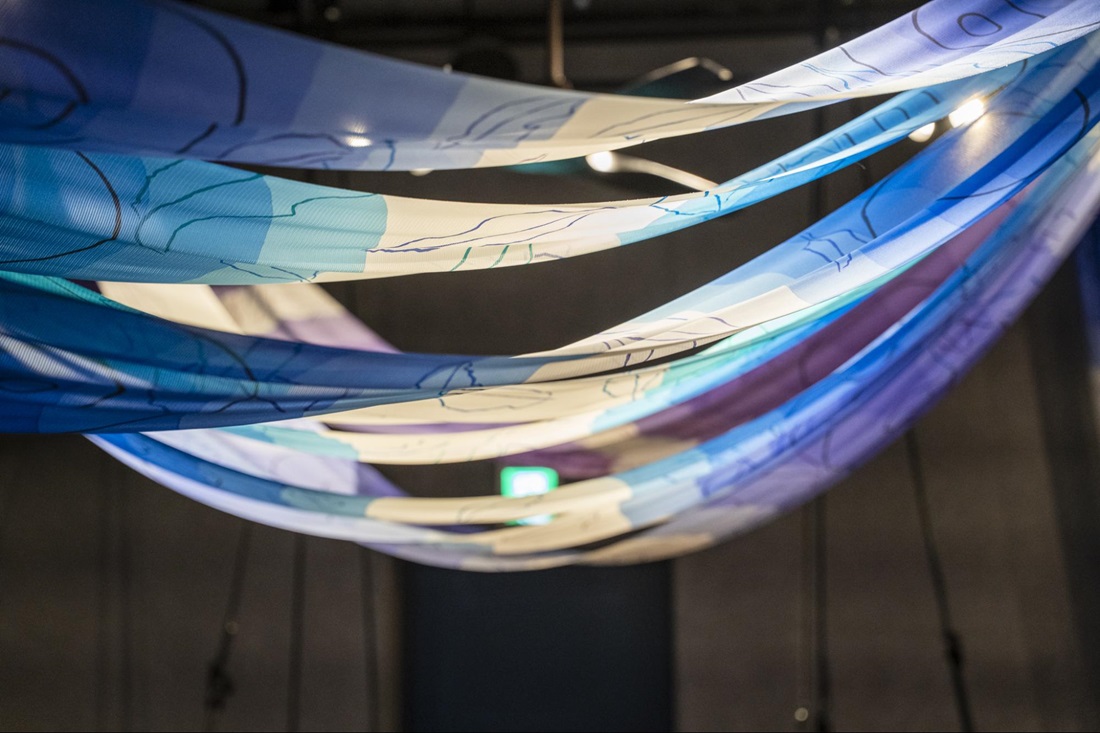
Broad, layered tones suggest the surface of rippling water, while fine lines trace floating leaves and expanding rings across the silk. Light filtering through the translucent fabric creates a gentle shimmer—like reflections drifting across a still pond—bringing a sense of calm and quiet movement to the space.
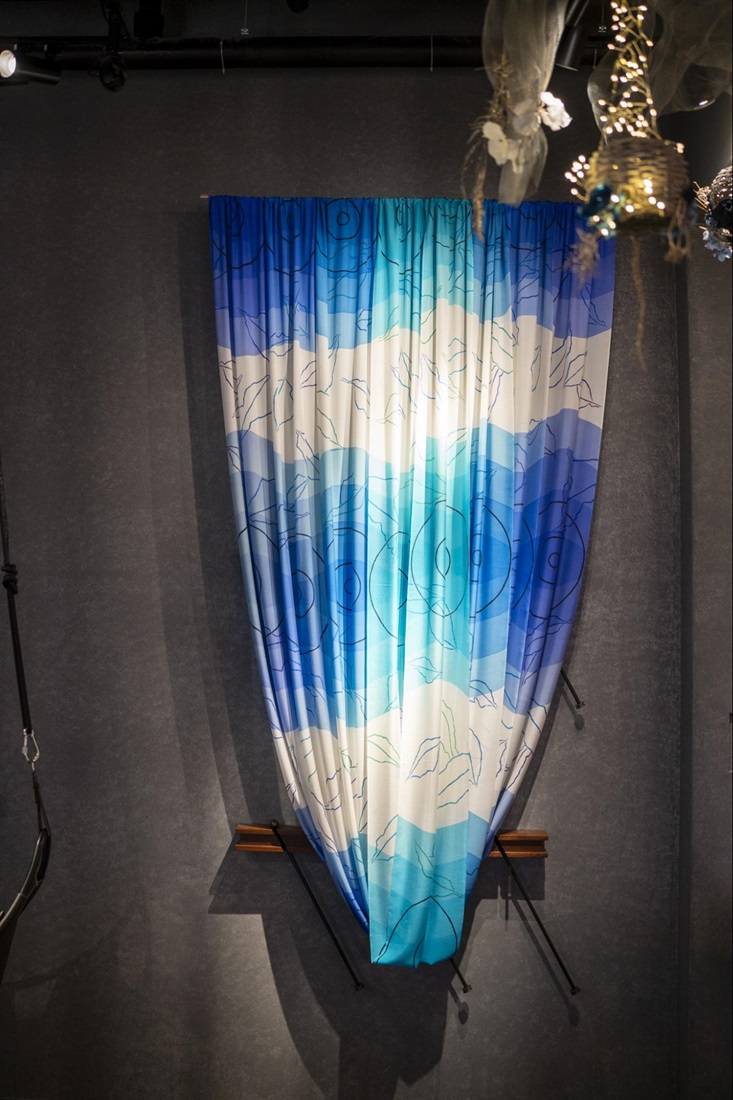
Other works—bundles of dyed cloth suspended like translucent curtains, or single panels woven through a suspended wooden armature—extend Okada’s world into pockets throughout the lounge.
Rōketsu-zome is a traditional Japanese dyeing technique introduced from Tang-dynasty China during the Nara period. Using wax as a resist, the process creates rich, layered coloration: melted wax is brushed onto the cloth, and once it cools and hardens, only the exposed fabric absorbs the dye.
Although the method itself is ancient, its use as fine art rather than for garments is relatively modern, emerging between the late Meiji and early Taishō periods. Even today, wax-resist works are most often presented in flat forms such as folding screens or wall hangings. Okada’s approach breaks from that convention.
Rather than treating fabric as a surface, he embraces its natural softness, shaping it into spatial installations designed to exist within contemporary living spaces. “There’s really no one else in my field doing this,” he says with quiet confidence.
His work favors open, breathable environments, places where fabric can respond to air, light, and the movement of people. Wax-resist dyeing creates minimal visual difference between the front and back of the cloth, and it is precisely this quality that allows Okada’s textile works to unfold fully in three dimensions.
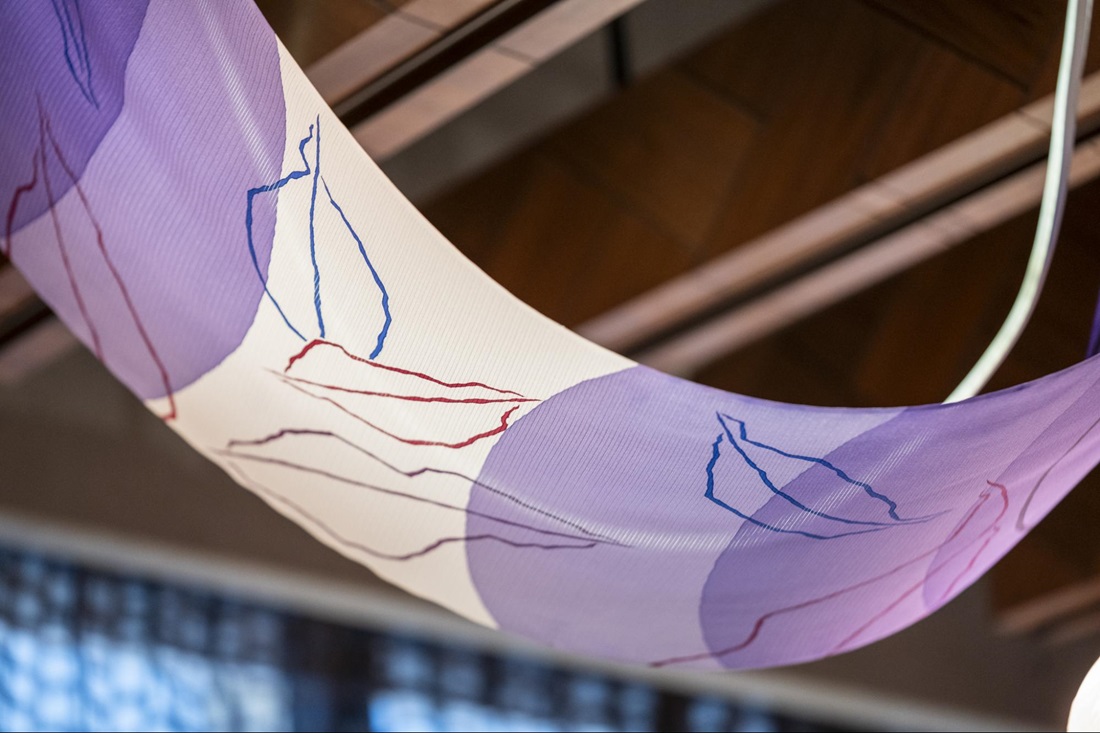
Though the works appear restrained in imagery, completing them takes nearly a year. Each layer demands patience. After dyeing the large color fields that suggest water, Okada carefully removes the wax, fixes the color, and allows the fabric to dry completely before moving on to the next sequence of lines and motifs.
Details such as rippling water and fallen leaves are never painted directly onto the cloth. Instead, their contours are first drawn in wax, creating fine channels that guide the dye precisely where it should flow. “If you paint directly, the color bleeds,” Okada explains. “You lose the sharp edges and the clarity.”
That sense of precision, the crisp & unmistakable outlines, is a defining trait of this body of work. While some artists intentionally use waxes that crack, allowing the dye to seep into the fissures and introduce an element of chance, Okada chooses a petroleum-based wax designed to stay intact. As the dye settles against the firm wax edges and dries, the boundaries between colors remain strikingly clear, visible even from a distance.
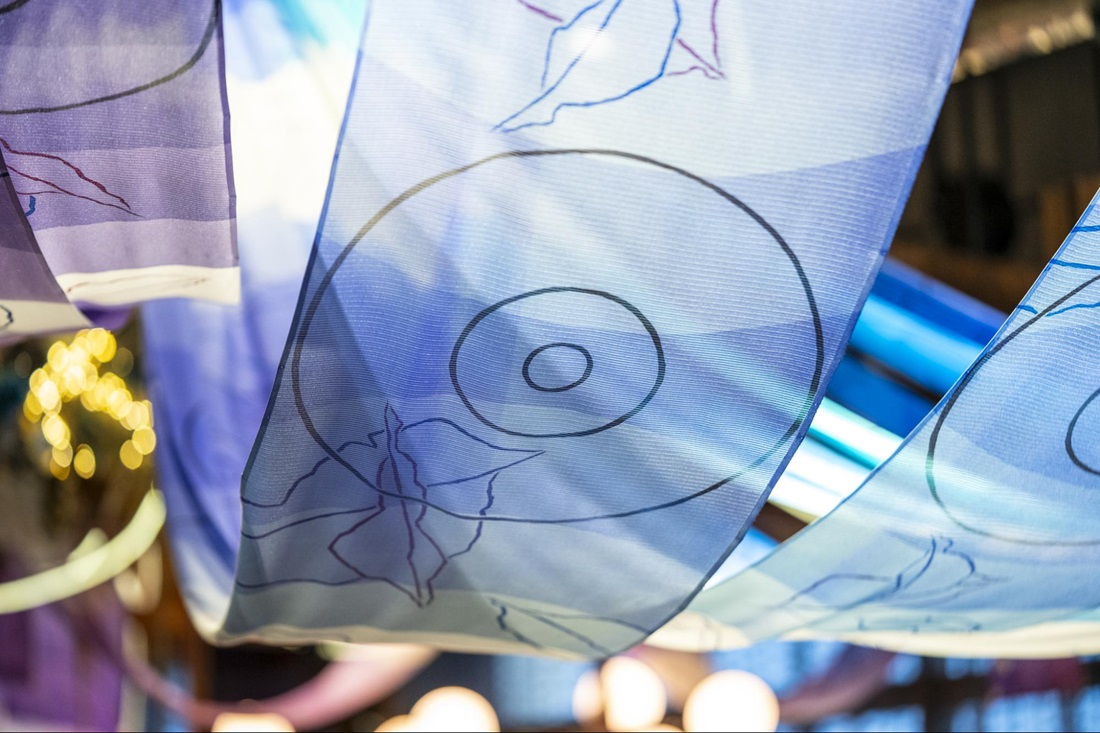
Okada’s choice of materials reflects a deeper way of working. He is not an artist who relies on chance. Rōketsu-zome allows no reversals: once a color is applied, it cannot be erased, and areas coated in wax remain untouched by dye until the wax is carefully removed. For that reason, each piece must be fully envisioned from the outset, with its overall structure mapped out long before the first dye bath begins. As layers of color are added, Okada must also anticipate the precise tones that will emerge in between.
“The big picture is already there before I start dyeing,” he explains. “The dyeing itself is, in a sense, execution. Looking back, given my temperament, I’m glad I chose a craft that rewards planning.”
This year marks Okada’s forty-seventh year working with wax-resist dyeing—a path he says began almost by chance, despite an early fascination with three-dimensional form. Standing before the works now filling the lounge, a quiet convergence becomes clear: a traditionally flat medium brought into motion, and a sense of calm order born from a process guided by careful foresight and control.
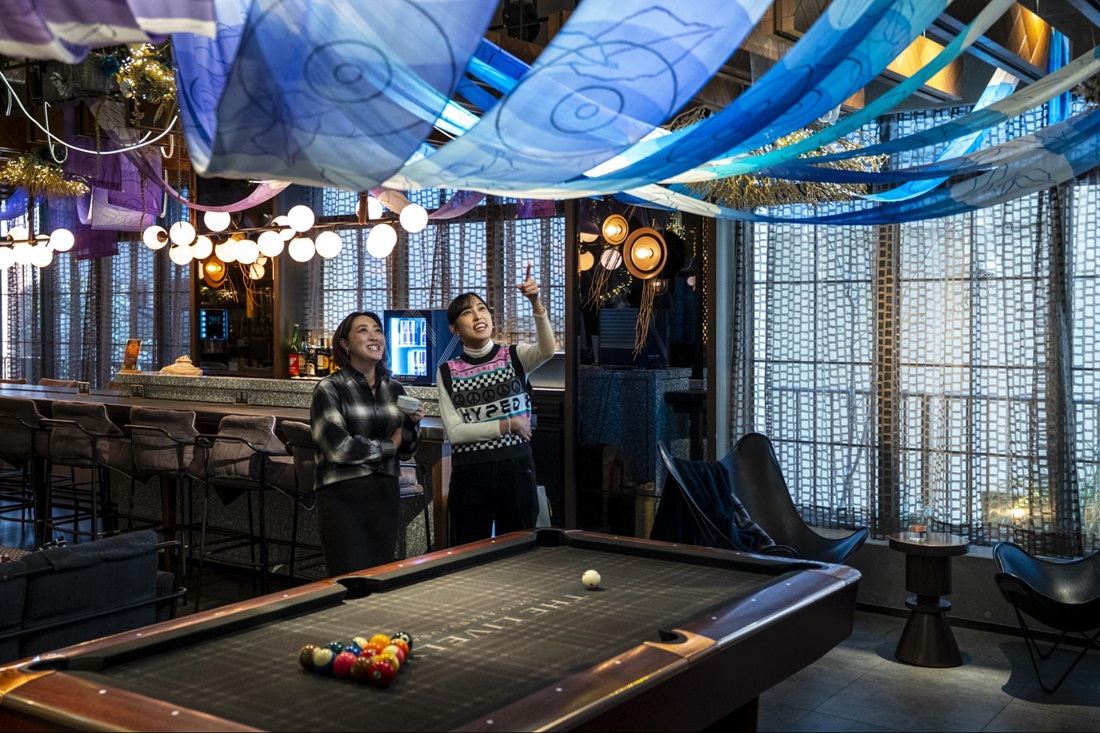
The exhibition runs through January 31st, 2026. Whether experienced from a distance as a sculptural presence or up close in the fine patterns and harmonized colors, the works invite multiple ways of looking. Visitors are warmly encouraged to stop by and experience the quiet beauty of Okada’s rōketsu-zome in person.
Event Detail
- Exhibition: Wax-Resist Dyeing Artist Akihiko Okada “Water & Leaf Shadows”
- Location: THE LIVELY TOKYO AZABUJUBAN Lounge 2F
- Period: Friday, November 14, 2025 – Saturday, January 31, 2026
Please feel free to check out our Instagram posts as well!
Roketsu – zome Artist Akihiko Okada
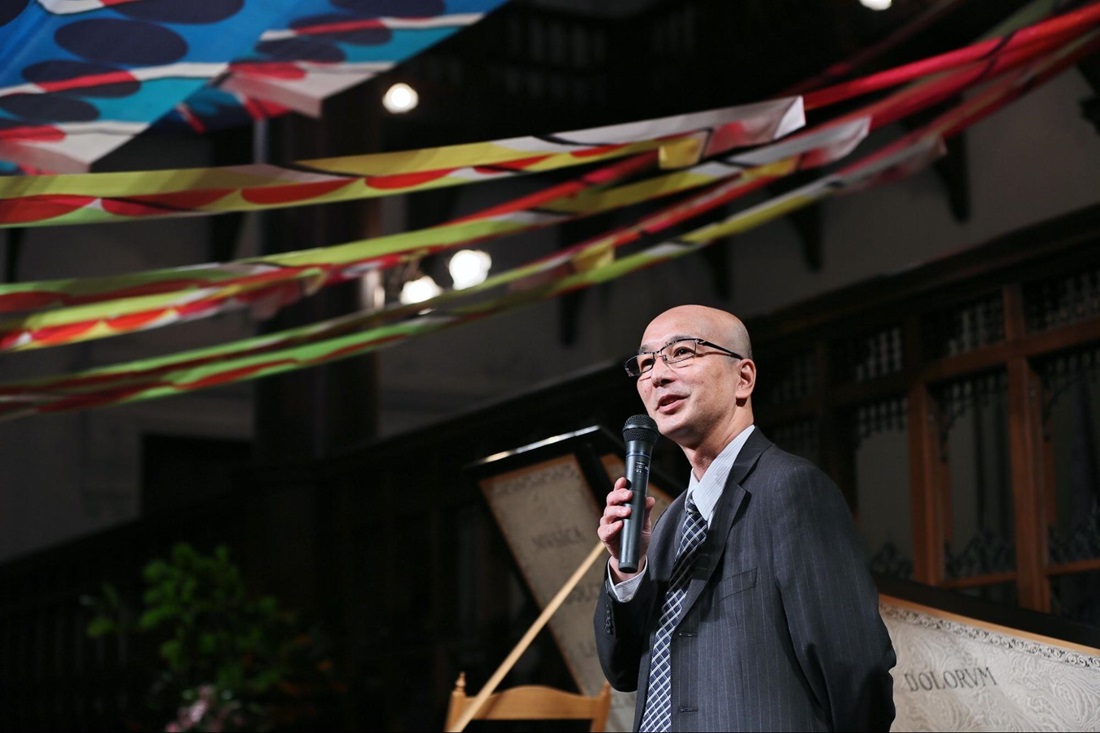
Became an apprentice to a Kyoto-based batik dyeing artist 47 years ago. Honed his skills while working at a kimono shop, and was selected multiple times for the Japan New Crafts Exhibition. Has held solo exhibitions regularly since 2005. Before the pandemic, he traveled widely, conducting workshop tours to share the appeal of batik dyeing.
THE LIVELY TOKYO AZABUJUBAN
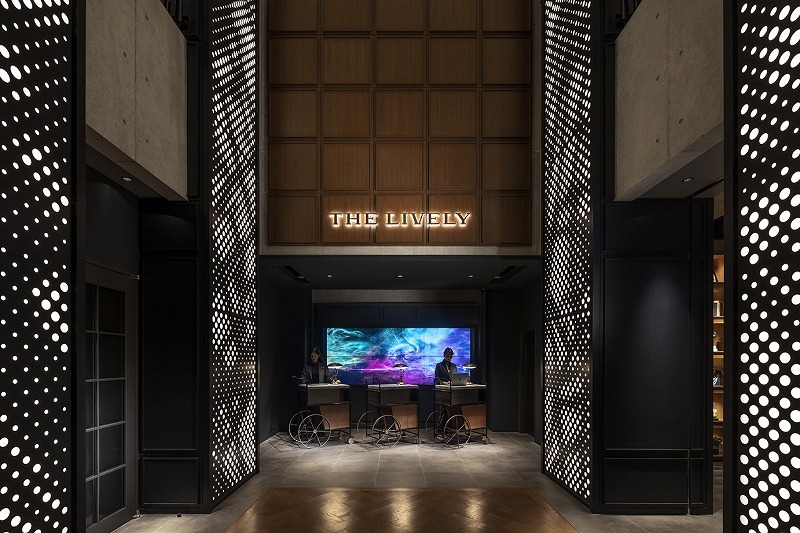
- Name:THE LIVELY TOKYO AZABUJUBAN
- Address:1 Chome-5-23 Azabujuban, Minato-ku, Tokyo, Japan 106-0045
- Access:
- 3-minute walk from Azabu-juban Station on the Namboku Line and Toei Subway Oeben Line
- 10 minutes walk from “Roppongi” station (Tokyo Metro Hibiya Line / Toei Subway Oeben Line)